Green Roofs
Green roofs capture stormwater where it falls. With three main designs and many options for vegetation and layout, green roofs are an innovative way for developers to add green spaces to urban areas. Green roofs have the benefit of lowering energy costs, helping with storm water management, and providing new habitats to developed areas. For these reasons, green roofs are becoming an increasingly popular investment for urban planners and developers.
Types of Green roofs
Extensive green roofs are the simplest of the three and have a thin soil layer and hardy plants such as succulents. This type is lightweight and requires little maintenance
Intensive green roofs have a thicker soil layer and contain a wide variety of plants. These may require greater structural support and maintenance.
Semi-intensive green roofs lie in between intensive and extensive green roofs. They contain a slightly thicker soil layer than an extensive roof but may have fewer plants and be lighter than an intensive roof.
Why a Green Roof?
Green roofs are capable of infiltrating up to 90% of the storm water that falls on them, preventing storm sewer overflow and excess runoff.
A green roof can double your roof’s lifespan!
The vegetation on green roofs provide shade and perform evapotranspiration, naturally lowering ambient air and surface temperatures in urban ‘heat islands’.
Green roofs provide aesthetic beauty and habitat in urban areas. Green spaces have been proven to give positive psychological effects to residents and visitors.

Example of a green roof with flowering vegetation.
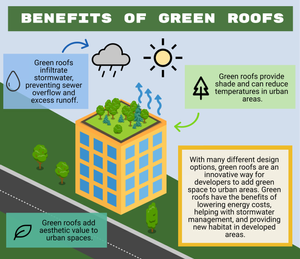
Informational graphic displaying the many benefits of installing green roofs in urban areas.